
Pneumatic Valve Actuators
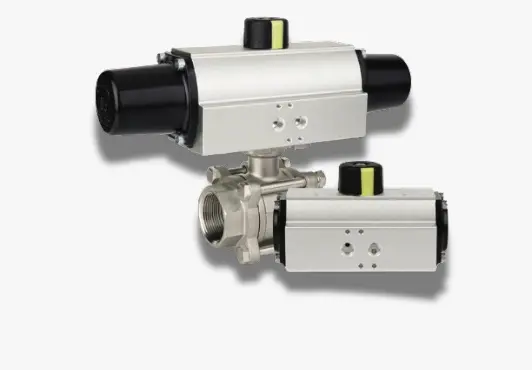
KOSAPLUS pneumatic valve actuators provide compressed-air-powered actuation for automated rotary valve applications. Choosing a suitable pneumatic actuator means matching the actuator's operating mechanism and output torque to the valve, the available air supply and the required operating action.
- Max torque (A300)
- 10,000+ Nm
- Temperature options
- -40 to 200°C
- Certified
- CE · SIL 3 · ATEX
Description
Choose The Mechanism
Certified For Safety
Every certificate is issued to KOSAPLUS by an independent body and lists the models it covers.
All certificatesModel range
Every Pneumatic Actuator Series
Reading a model name
AD65
Part 1
- A
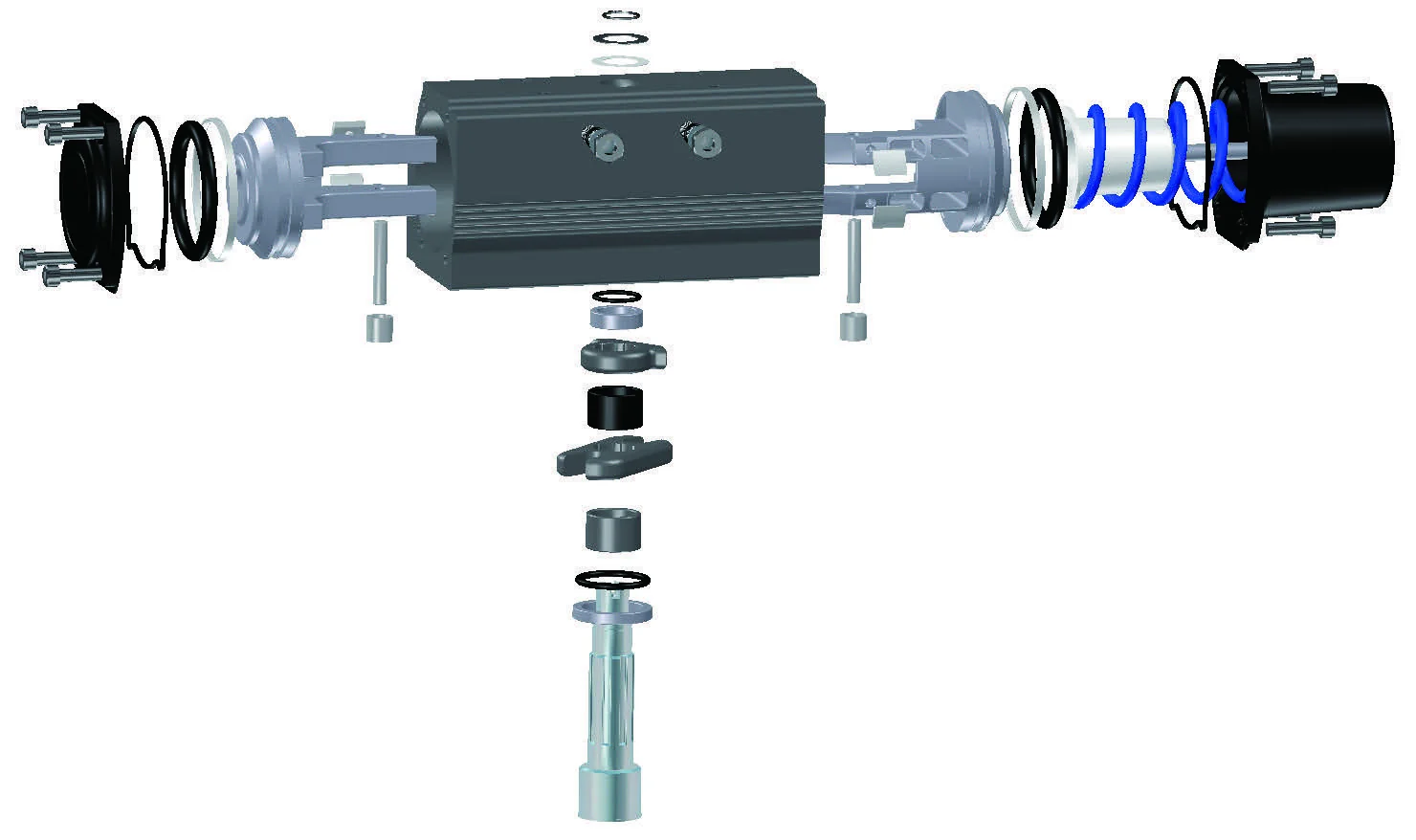
- Scotch yoke
- R
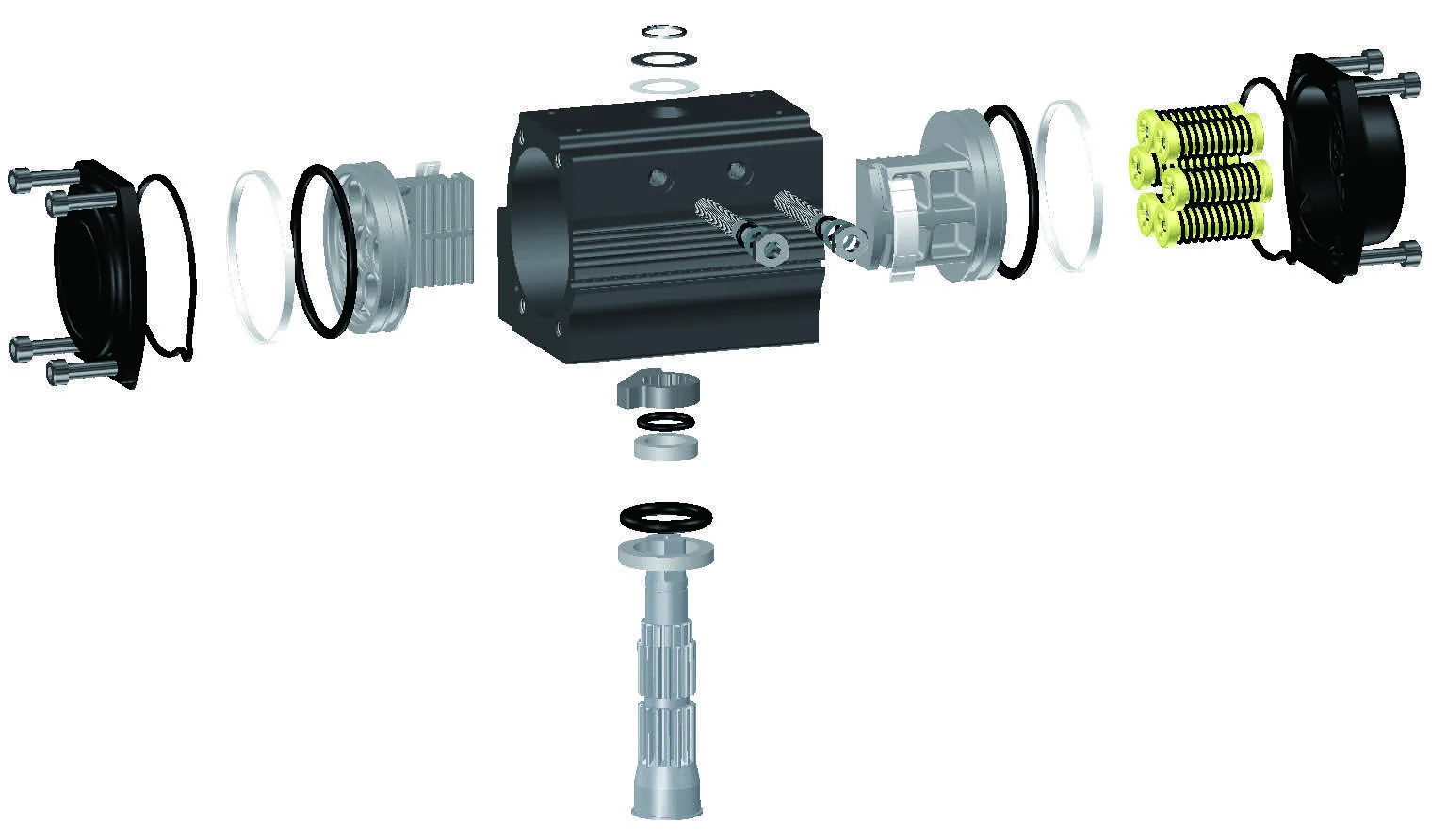
- Rack & pinion
Part 2
- D
- Double acting
- S
- Spring return
Part 3
- Internal diameter (mm)
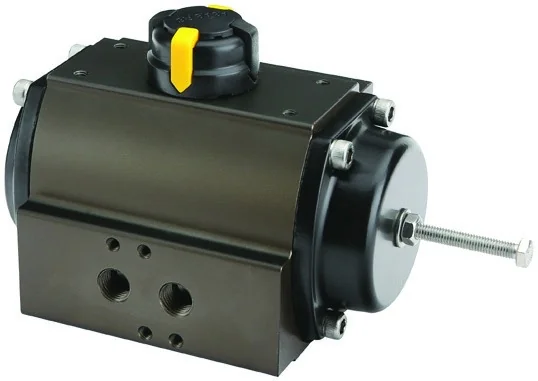
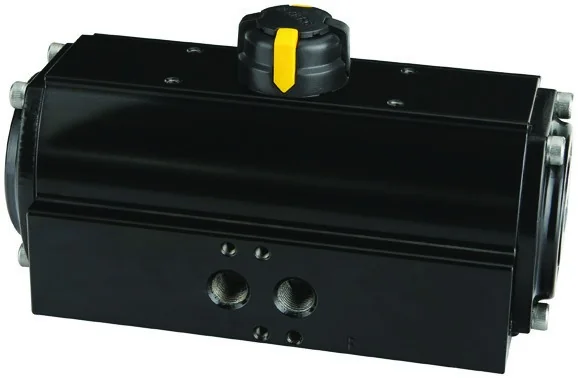
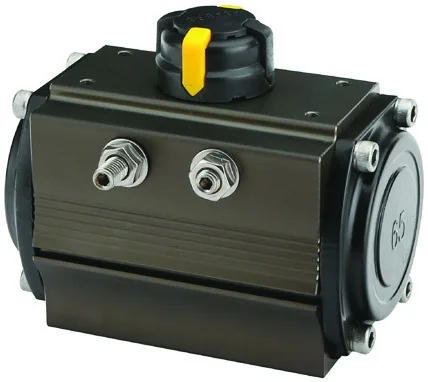
Blue models have a price online. AD and AS and RD and RS models open the configurator with that size chosen; click any other model for its details.
Selection guide
Choosing A Pneumatic Valve Actuator
Five steps from your valve to a quote. The buying guide explains each one in detail.
- 1
Know your valve
Its type, size and mounting, and its operating torque from the valve manufacturer.
- 2
Check your air supply
The minimum and normal air pressure available at the actuator.
- 3
Choose the action
Double acting, or spring return with a confirmed return position.
- 4
Choose the mechanism and size
Compare output torque at your air pressure across the full stroke.
Compare all models - 5
Configure and request a quote
Pick the build and add-ons; we check the complete assembly with you.
Request a quote
Model code
Read A Full Model Code
Each part of the full code stands for one choice in how the unit is built.
This example reads: An AD65 (scotch yoke, double acting, 65 mm) with NBR O-rings, action A (fail closed), black body and end cap, F10 and F12 flanges, a 27 × 27 mm stem and an option code.
- A
Mechanism
Scotch yoke
- A
- Scotch yoke
- R
- Rack & pinion
- 6
Diameter
65 mm
- 3
- 32 mm
- 4
- 40 mm
- 5
- 50 mm
- 6
- 65 mm
- 8
- 80 mm
- 10
- 100 mm
- 11
- 115 mm
- 12
- 125 mm
- 14
- 140 mm
- 16
- 160 mm
- 18
- 185 mm
- 21
- 210 mm
- 25
- 250 mm
- 30
- 300 mm
The internal diameter, the number in the model name (AD65).
- N
O-ring
NBR
- N
- NBR
- V
- Viton
- E
- EPDM
- S
- Silicone
- D
Spring
Double acting, no spring
- D
- Double acting
- W
- Weak spring
- M
- Middle spring
- S
- Strong spring
D makes it an AD or RD; a spring makes it an AS or RS. Rack & pinion: a number gives the springs' quantity.
- A
Action
Action A, fail closed
- A
- Fail closed
- B
- Fail open
- C
- Fail closed, opens clockwise
- D
- Fail open, opens clockwise
- K
Body colour
Black
- K
- Black
- L
- Blue
- W
- White
- Y
- Yellow
- R
- Red
- K
End cap colour
Black
- K
- Black
- L
- Blue
- R
- Red
- 1012
ISO 5211 flange
F10 and F12
- 3
- F03
- 5
- F05
- 7
- F07
- 10
- F10
- 12
- F12
- 14
- F14
- 16
- F16
Two numbers mean two flanges: 1012 is F10 + F12.
- C27
Stem
27 × 27 mm square
- C11
- 11 × 11 mm
- C14
- 14 × 14 mm
- C17
- 17 × 17 mm
- C19
- 19 × 19 mm
- C22
- 22 × 22 mm
- C27
- 27 × 27 mm
- C36
- 36 × 36 mm
- C46
- 46 × 46 mm
- OP
Option
Option code, e.g. the air connection
- T4
- PT 1/4
- T8
- PT 3/8
- T2
- PT 1/2
- N4
- NPT 1/4
- N8
- NPT 3/8
- N2
- NPT 1/2
- F4
- PF 1/4
- F8
- PF 3/8
- F2
- PF 1/2
Highlighted in each row: the choice used in the example code.
Options
Built For Your Application
Add-ons fitted by KOSAPLUS to your actuators. Add them while you configure your actuator, or tell us which ones you need in your quote.
Need any of these add-ons?
Choose your actuator first: on a series marked Configurable online you can add them to the build, otherwise list them in your quote.
Documents
Everything For Your Pneumatic Actuators
E-Catalogue
Pneumatic Actuator Catalogue
Every AD, AS, RD and RS model: torque tables, dimensions, flanges and stems, model code and options
KOSAPLUS v5.6 · Nov 2024 · 20 pages · PDF 5.7 MB
Manuals and technical data
User manual
Installation, operation and maintenance (English, Mar 2025)
PDF · 0.9 MB
User manual (Korean)
사용자 매뉴얼 (Mar 2025)
PDF · 0.8 MB
Air consumption
Air volume per stroke for every model (v08)
PDF · 150 KB
Operating time
Opening and closing times per model (v03)
PDF · 45 KB
Operating mechanism
Fail closed and fail open: Actions A, B, C and D
PDF · 60 KB
Sensing indicator
Position indicator with sensors (v00)
PDF · 200 KB
Drawings And CAD Files
Pick a model for its dimension drawing, and download it as PDF, DWG or a 3D STEP model.
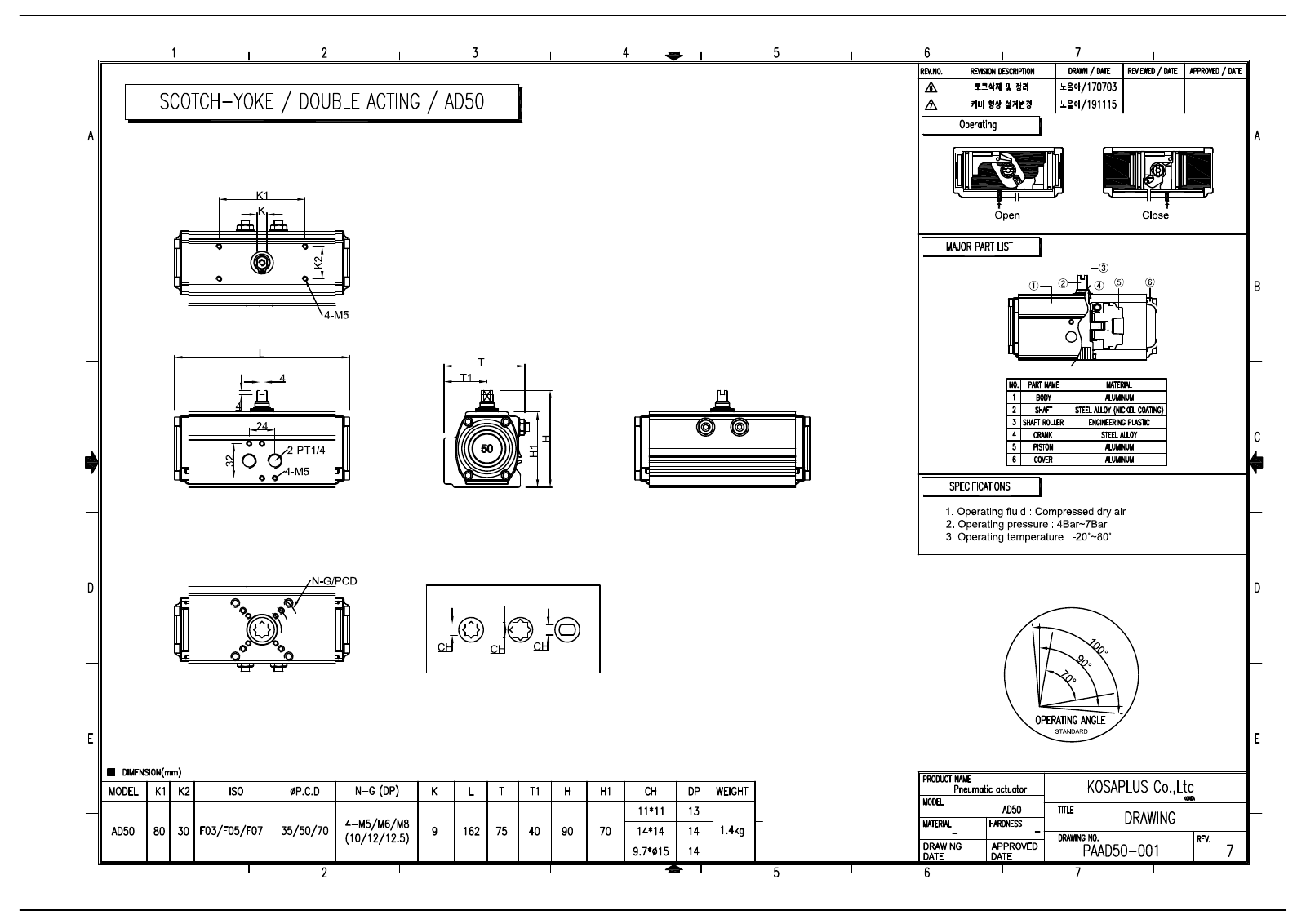
AD Series · Scotch Yoke
AD50
- Diameter
- 50 mm
- ISO 5211
- F03 / F05 / F07
- Torque at 6 bar
- 27 – 53 Nm
FAQ
Frequently Asked Questions
A pneumatic valve actuator uses compressed air to produce movement that operates a compatible valve. Rotary pneumatic actuators are commonly used with quarter-turn valve designs, subject to torque and interface compatibility.
They use different mechanisms to convert piston movement into rotary output and can have different torque characteristics and physical layouts. Compare the manufacturer's torque charts and dimensions for the specific models being considered.
Double-acting actuators use air to drive movement in both directions. Spring-return actuators use air for one direction and a spring for the return movement. Confirm the required fail position and configuration for the application.
The KOSAPLUS range identifies AD as Scotch yoke double acting, AS as Scotch yoke spring return, RD as rack-and-pinion double acting, and RS as rack-and-pinion spring return.
Start with the valve manufacturer's torque requirements under the actual operating conditions, then compare these with the actuator's output torque at the available air pressure or selected spring configuration. Check mounting compatibility and the full operating range before confirming a model.
Still have a question?
Send your valve type, size, torque and air supply, and we will help you choose the right series and model.
Ask our teamRead the buying guide