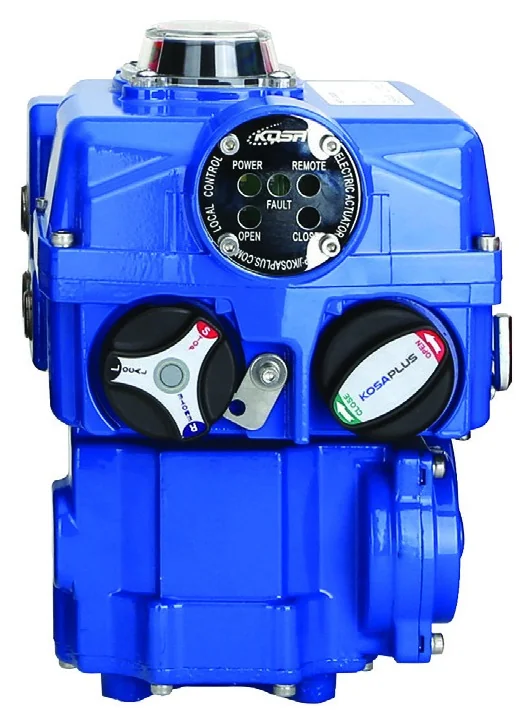
Choosing a pneumatic rotary actuator involves more than matching the actuator to the nominal valve size. The actuator must provide enough output torque for the valve under its real operating conditions, work with the available compressed-air supply and fit the valve's mounting arrangement. You also need to decide whether the application requires double-acting operation or a spring-return action.
This guide explains the main decisions to make before selecting a KOSAPLUS pneumatic actuator. Always confirm the final selection against the current manufacturer's technical data and the valve supplier's requirements.
Key takeaways
- Size the actuator from the valve's operating torque under real service conditions, not from nominal valve size alone.
- Scotch yoke (AD, AS) and rack and pinion (RD, RS) differ in construction and torque behaviour: compare the exact model's torque chart.
- Double acting uses air in both directions; spring return uses a spring when the driving air is released. Confirm the fail position for the complete assembly.
- Check air pressure, operating conditions, mounting dimensions and accessories before ordering.
Step 1 of 6
Confirm the valve and application
Start by identifying the valve that the actuator will operate. Record the valve type, manufacturer and model, nominal size, connection, process medium and operating conditions. If replacing an existing actuator, record its model and mounting details, but do not assume that the existing actuator is correctly sized for the current application.
- Valve type and model, including ball, butterfly or another compatible rotary valve.
- Valve operating torque data for the actual differential pressure, temperature and service conditions.
- Required movement, operating frequency and any process or safety requirements.
- Mounting standard, flange dimensions, stem dimensions, coupling and available installation space.
Step 2 of 6
Choose the actuator mechanism
KOSAPLUS offers Scotch yoke and rack-and-pinion pneumatic actuator designs. The mechanisms differ in construction and torque behaviour. The choice should be based on the valve's torque profile, required output, available space and the exact model's specifications.
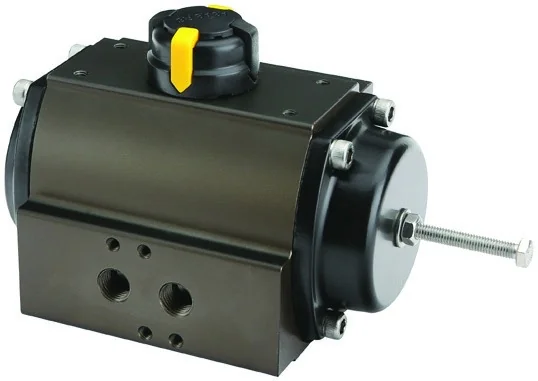
Scotch yoke, double acting
Air drives both directions of travel.
Scotch yoke, spring return
Air drives one way, a spring returns it.
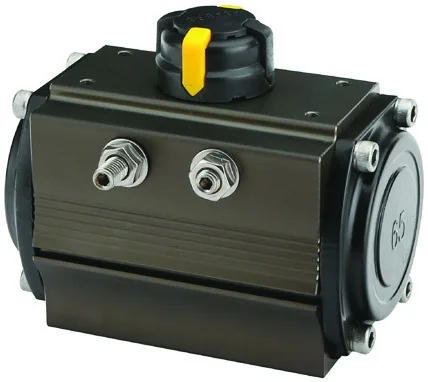
Rack and pinion, double acting
Air drives both directions of travel.
Rack and pinion, spring return
Air drives one way, a spring returns it.
Scotch yoke — AD and AS series. The Scotch yoke mechanism converts piston travel into rotary motion through a yoke. KOSAPLUS positions this design for applications where its torque characteristics are suitable, including higher-torque applications. Review the torque curve and dimensions for the specific model rather than selecting by mechanism name alone.
Rack and pinion — RD and RS series. The rack-and-pinion mechanism converts linear movement into rotary movement through a rack and pinion. Consider it where the design's torque characteristics, form factor and interface suit the installation. Confirm the model's torque data and dimensions before selection.
Step 3 of 6
Decide between double acting and spring return
AD and RD series
Double acting
Compressed air drives the actuator in both directions. This may suit applications where air is available for both opening and closing and the control system is designed around that operating mode.
AS and RS series
Spring return
Compressed air drives movement in one direction and a spring provides the return movement when the driving air is released, depending on the configuration. Confirm whether the required return position is open or closed, the spring arrangement and the complete valve assembly's behaviour.
Important:Fail position is an application-level requirement. Confirm actuator orientation, valve action, spring configuration and any accessories with the manufacturer or a qualified engineer. Do not infer fail-open or fail-closed behaviour from the series name alone.
Step 4 of 6
Match actuator torque to valve torque
Torque is one of the most important criteria when selecting a rotary actuator. The required torque can vary with valve design, seat materials, differential pressure, temperature, process medium and the valve's position in its operating cycle. Use valve-specific data rather than a general valve-size chart wherever possible.
- Obtain the valve manufacturer's required operating torque for the actual service conditions.
- Identify the available air pressure at the actuator, including any expected pressure variation.
- Use the KOSAPLUS torque chart for the exact actuator model and selected action to find its available output torque (see the model tables and the catalogue).
- Check the torque across the complete stroke and the relevant opening, running and closing conditions.
- Apply the required sizing margin in line with the valve and actuator manufacturers' guidance and the project specification.
- Have the proposed actuator/valve combination technically checked before ordering or installation.
Important:Do not size an actuator from nominal valve size alone.
Step 5 of 6
Check air supply and operating conditions
Confirm the minimum and normal air pressure available at the actuator and compare it with the manufacturer's stated operating range. Also review air quality, temperature, seal compatibility, corrosion protection, operating frequency and any environmental or hazardous-area requirements. Select only configurations whose published specifications meet the application.
Step 6 of 6
Verify mounting and accessories
Before finalising the selection, check the actuator mounting interface, valve stem and coupling dimensions, bracket requirements and available space. Confirm whether the installation requires accessories such as a solenoid valve, position indicator, limit switch box, positioner or air preparation equipment. Verify the compatibility and ratings of the complete assembly.
FAQ
Frequently asked questions
No. Suitability depends on valve design, torque requirements, mounting compatibility, operating conditions and the actuator's available output. Check the manufacturer's data for the specific combination.
No. Valve size is not a substitute for valve operating torque. Obtain torque data for the actual service conditions and compare it with the actuator's published output torque.
Compare the torque characteristics, dimensions and specifications of the exact models with the valve requirements. Neither mechanism is universally best for every application.
Consider spring return where the process or risk assessment requires the actuator to return to a defined position when the driving air is released. Confirm the required position and configuration for the complete assembly.
Provide the valve make/model and size, operating torque if known, available air pressure, required action and return position, mounting details, operating conditions and any accessories or certification requirements.

Written by
Kosaplus UK Team
Authorised UK distributor of KOSAPLUS pneumatic and electric valve actuators, part of Valvenok Ltd.
Need help with actuator selection?
Contact Kosaplus UK with your valve details and operating requirements, and we will help identify a suitable KOSAPLUS actuator model for technical review.