
- 1What is a pneumatic actuator?
- 2What is an electric actuator?
- 3Pneumatic vs electric actuators: key differences
- 4Installation and integration
- 5Control and positioning: which performs better?
- 6Maintenance and long-term operating costs
- 7Typical applications
- 8How to choose the right actuator for your application
- ?Frequently asked questions
Choosing the right actuator is an important part of designing an efficient and reliable industrial system. Whether you are automating a ball valve, controlling process flow or integrating equipment into a production line, the actuator must meet the requirements of the application.
Two of the most widely used industrial actuator types are pneumatic and electric actuators. Both convert an energy source into mechanical movement, but they differ in how they operate, how they are controlled and where they perform best.
So, which is better: pneumatic or electric actuation? The answer depends on your operating environment, required torque, positioning accuracy, available utilities, maintenance requirements and overall operating costs. In this guide, we compare pneumatic vs electric actuators to help engineers, maintenance teams and purchasing professionals make a more informed decision.
Key takeaways
- Pneumatic actuators use compressed air and are often well suited to fast, repetitive operation where air is already available.
- Electric actuators use a motor and are often preferred for accurate positioning and electronic control, with no compressed-air network needed.
- Spring-return pneumatic designs give a defined response to air loss; an electric actuator needs a specified spring-return, stored-energy or backup arrangement.
- Compare the complete installation and the total cost of ownership, not just the actuator.
Part 1 of 8
What is a pneumatic actuator?
A pneumatic actuator uses compressed air to generate mechanical movement. Depending on its design, it can produce linear or rotary motion to operate industrial equipment, including automated valves. In valve automation, pneumatic actuators are commonly used to open, close or position valves in process systems.
How does a pneumatic actuator work?
Compressed air enters the actuator and moves an internal piston or mechanism. This movement is converted into force or torque, which operates the connected valve. Pneumatic valve actuators commonly use two operating configurations:
- Double-acting actuators: compressed air drives movement in both directions (KOSAPLUS AD and RD series).
- Spring-return actuators: compressed air moves the actuator in one direction, while a spring provides the return movement when air pressure is released (KOSAPLUS AS and RS series).
Spring-return configurations can be designed to move a valve to a specified fail-safe position, such as open or closed. The correct arrangement depends on the valve, actuator and process requirements.
Advantages of pneumatic actuators
- Fast operation: suitable for many applications requiring rapid, repetitive movement.
- Robust construction: well suited to demanding industrial environments when correctly specified.
- High torque potential: certain designs provide substantial torque within a compact assembly.
- Simple operating principle: particularly effective for straightforward open-and-close duties.
- Spring-return options: can provide a defined response to loss of air pressure.
Potential limitations
Pneumatic actuators require a dependable compressed-air supply, along with appropriate air preparation, control equipment and distribution pipework. Air leaks, contamination or moisture can affect performance. Applications requiring precise intermediate positioning may also need additional control equipment, such as a positioner.
Part 2 of 8
What is an electric actuator?
An electric actuator uses an electric motor to produce mechanical movement. Gears, screws or other transmission mechanisms convert the motor's output into the required linear or rotary motion. Electric actuators are used in industrial automation where controlled movement, adjustable positioning or integration with electronic control systems is important.
How does an electric actuator work?
An electrical supply powers the motor, which drives the actuator mechanism. Depending on the model and control system, the actuator can move to defined positions or adjust its movement in response to a control signal. For automated valves, electric actuators can provide on/off operation or modulating control, allowing the valve to move to intermediate positions when the actuator and control system support that function.
Advantages of electric actuators
- Precise positioning: suitable for applications requiring accurate, repeatable movement.
- Flexible control: speed, position and movement profiles can be adjusted on compatible systems.
- No compressed-air network required: useful where a suitable electrical supply is available but compressed air is not.
- Control-system integration: many models support position feedback, electronic controls or communication interfaces.
- Potential energy savings: can be efficient in suitable applications, particularly when the full system is designed to minimise energy consumption.
Potential limitations
Electric actuators require a suitable electrical supply and appropriate wiring and control arrangements. Their motors, gearing and electronic components must be selected for the operating environment. Hazardous locations may require specifically certified equipment, while certain high-speed or high-cycle applications may favour pneumatic alternatives.
Important:A standard electric actuator should not automatically be assumed to move to a safe position if power fails. Any required fail-safe action must be specified and supported by the actuator design or an appropriate backup arrangement.
Part 3 of 8
Pneumatic vs electric actuators: key differences
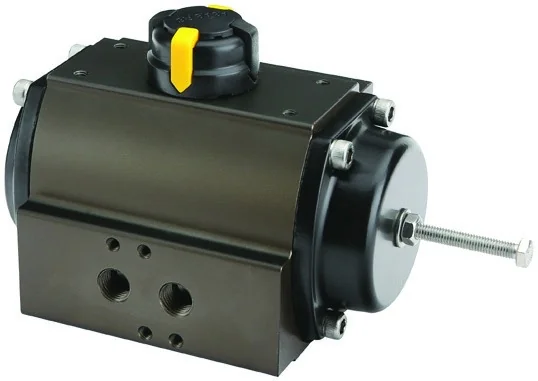
Compressed air
Pneumatic actuator
Can be an effective choice for fast, repetitive operation, particularly where compressed air is already available.
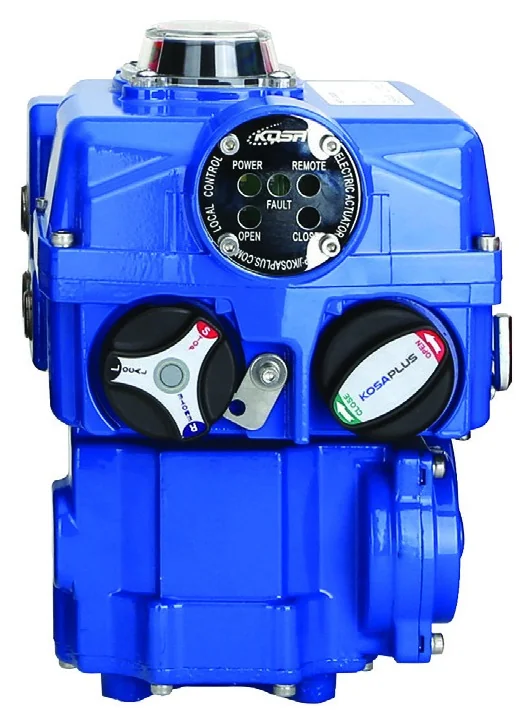
Electricity
Electric actuator
Can be better suited to applications requiring precise positioning, flexible control or integration with electronic systems.
The table below summarises the main differences between the two technologies.
| Comparison | Pneumatic actuator | Electric actuator |
|---|---|---|
| Energy source | Compressed air | Electricity |
| Operating mechanism | Air pressure drives an internal mechanism | Electric motor drives a mechanical transmission |
| Speed | Often advantageous for rapid, repetitive movements | Depends on motor, gearing and control configuration |
| Positioning | Well suited to end-position operation; intermediate positioning may require additional control | Often well suited to accurate, programmable positioning |
| Installation | Requires air supply, tubing and control equipment | Requires electrical supply, wiring and suitable controls |
| Maintenance | Air quality, leaks, seals and springs may require attention | Motor, gearing, seals, sensors and electronics may require attention |
| Fail-safe options | Spring-return designs can provide a defined response to air loss | Requires a suitable spring-return, stored-energy or backup arrangement if a defined response to power loss is needed |
| Running costs | Include compressed-air generation, treatment and distribution | Include electrical consumption and any associated control equipment |
| Typical applications | Rapid on/off operation and repetitive industrial movements | Position control, adjustable movement and electronically integrated automation |
Energy source
Operating mechanism
Speed
Positioning
Installation
Maintenance
Fail-safe options
Running costs
Typical applications
These are general comparisons rather than absolute rules. Performance, reliability and cost depend on the particular actuator model, application and installation.
Part 4 of 8
Installation and integration
Installation requirements can influence the overall cost and practicality of an actuator selection.
Installing pneumatic actuators
Pneumatic systems need access to a suitable compressed-air supply. Depending on the installation, additional components may include filters, regulators, directional control valves, solenoid valves, tubing and fittings. If the site already has a suitable compressed-air network, integrating a pneumatic actuator may be straightforward. However, a new air supply infrastructure can increase installation complexity and cost.
Installing electric actuators
Electric actuators require suitable electrical power, wiring, protection and any necessary control equipment. For sites without compressed air, an electric actuator may offer a simpler installation. Where remote operation, position feedback or automated process control is required, the selected model must provide the appropriate interfaces and functionality.
Selection tip:Compare the complete installation rather than the actuator alone. Air preparation, wiring, control equipment, commissioning and maintenance access can all affect the final decision.
Part 5 of 8
Control and positioning: which performs better?
Control requirements are often one of the most important factors when choosing between pneumatic and electric actuators.
When pneumatic control makes sense
Pneumatic actuators are particularly suitable for applications where equipment needs to move quickly between defined positions. They are frequently used in automated valve systems requiring repeated opening and closing. Pneumatic actuators can also provide modulating control when equipped with a suitable positioner and compatible control system.
When electric control makes sense
Electric actuators are often a strong option where accurate positioning, adjustable movement or integration with digital control systems is required. Depending on the model, they can support position feedback, programmable movement and modulating operation. These capabilities are useful when the actuator needs to respond to changing process conditions.
The best choice depends on the required level of control. Pneumatic does not necessarily mean basic control, and electric does not automatically guarantee greater accuracy: the complete actuator and control configuration must meet the application requirements.
Part 6 of 8
Maintenance and long-term operating costs
The initial purchase price is only one part of the cost of an actuator. Buyers should also consider energy consumption, servicing, replacement parts and the consequences of unplanned downtime.
Pneumatic actuator maintenance
- Inspecting air lines and fittings for leaks.
- Checking air quality and moisture control.
- Inspecting seals and other wear components.
- Checking mounting hardware and mechanical connections.
- Verifying operating speed and end-position performance.
A well-maintained compressed-air system is important for consistent actuator performance.
Electric actuator maintenance
Maintenance requirements depend on the actuator's construction and operating conditions. Checks may include:
- Inspecting electrical connections and cable condition.
- Checking mounting hardware and mechanical components.
- Reviewing position feedback and control operation.
- Inspecting seals and environmental protection.
- Checking the condition of gears, motors and other serviceable components as recommended by the manufacturer.
Electric actuation can reduce dependence on compressed-air infrastructure, but it is not maintenance-free.
Which is more cost-effective?
There is no universal winner. Pneumatic actuation may offer an economical solution where compressed air is already available and the application requires straightforward, repetitive movement. Electric actuation may offer lower overall costs where compressed-air infrastructure would otherwise be needed or where its control capabilities improve process efficiency. A meaningful comparison should consider the total cost of ownership over the expected service life.
Part 7 of 8
Typical applications
Both actuator technologies are used across a wide range of industries. The following examples illustrate where each may be suitable.
Pneumatic actuators are commonly considered for
- Automated ball and butterfly valves.
- Rapid on/off valve operation.
- Repetitive movements in manufacturing equipment.
- Industrial process systems with an established compressed-air supply.
- Applications requiring spring-return operation, where the specified design meets the required safety function.
Electric actuators are commonly considered for
- Automated valves where compressed air is unavailable.
- Applications requiring accurate or adjustable positioning.
- Remote valve operation and electronic monitoring.
- Process systems using compatible digital control infrastructure.
- Applications where programmable movement or position feedback is beneficial.
The operating environment must always be assessed. Temperature, moisture, corrosion, vibration and hazardous-area requirements can influence which actuator design is appropriate.
Part 8 of 8
How to choose the right actuator for your application
Before selecting a pneumatic or electric actuator, work through the following considerations.
- Define the movement required. Determine whether the application requires simple open-and-close operation, linear movement or continuous positioning.
- Establish the torque or force requirement. For valve automation, the actuator must provide sufficient torque throughout the operating cycle under the specified conditions.
- Check the available energy supply. Confirm whether suitable compressed air or electrical power is available at the installation point.
- Define the required operating speed. Consider the opening or closing time, frequency of operation and any process restrictions.
- Identify the control requirements. Establish whether on/off operation is sufficient or whether modulating control, position feedback or remote monitoring is needed.
- Specify the required response to energy loss. Determine what the valve must do if the air supply or electrical power fails, and select a configuration capable of meeting that requirement.
- Assess the environment. Review temperature, moisture, corrosion, vibration and any hazardous-area certification requirements.
- Compare lifecycle costs. Include installation, energy, maintenance, replacement parts and potential downtime.
Pneumatic and electric actuators both play an important role in industrial automation, but their strengths differ. Pneumatic actuators can be an effective choice for fast, repetitive operation, particularly where compressed air is already available. Electric actuators can be better suited to applications requiring precise positioning, flexible control or integration with electronic systems. The most suitable solution is the one that meets the application's technical requirements while offering reliable operation and an appropriate lifecycle cost.
FAQ
Frequently asked questions
Neither is universally better. Pneumatic actuators are often well suited to fast, repetitive movements and applications with an established compressed-air supply. Electric actuators are often preferred where precise positioning, adjustable movement or electronic integration is important.
They can be, depending on the application. Electric actuators avoid the need to generate and distribute compressed air, but actual energy consumption depends on operating cycles, holding requirements, system design and control strategy.
Yes. Pneumatic actuators can support intermediate positioning and modulating control when fitted with suitable positioners, feedback and control equipment. Electric systems may provide a more straightforward route to precise programmable positioning in many applications.
Both pneumatic and electric actuators can operate compatible ball valves. The choice depends on required torque, operating speed, control method, available utilities, mounting compatibility and the response required if power or air is lost.
No. Electric actuators use electrical power to drive their motor. They may still require additional control equipment and suitable wiring, depending on the application.
Confirm the required valve torque, mounting interface, operating time, control signals, available power, environmental protection and required fail-safe behaviour. A replacement should be assessed as a complete system rather than selected solely by physical size.

Written by
Kosaplus UK Team
Authorised UK distributor of KOSAPLUS pneumatic and electric valve actuators, part of Valvenok Ltd.
Looking for the right actuator?
Kosaplus UK supplies KOSAPLUS pneumatic and electric actuators for industrial applications. If you are selecting an actuator for a new installation or reviewing an existing valve automation system, contact our team to discuss your requirements and identify a suitable solution.